Global warming or global heating is the rise in temperature of Earth’s air and oceans.[2] It is happening mainly because humans burn coal, oil, natural gas, and cut down forests.[3]
Average temperatures today are about 1.3 °C (2.3 °F) higher than before people started burning a lot of coal around 1750.[4] By the year 2100 temperatures will very likely be 1.5 °C (2.7 °F) to 4.5 °C (8.1 °F) higher than before 1900.[5]: 581, Fig. 4.1.1. (d) There will be more warming in the Arctic, on land and in the northern half of the world.[5]: 645
Although climate has changed before people started burning a lot of stuff, the last time the Earth was this hot was probably more than 100 thousand years ago.[6]
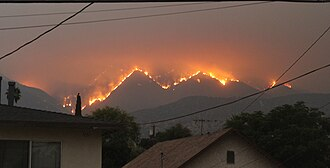
Global warming is probably getting faster.[7] It is making more heat waves and wildfires, and melting the ice around the North Pole.[2]
The present global warming is mostly because of people burning things, such as gasoline for cars and natural gas to keep houses warm. But the heat from the burning itself only makes the world a tiny bit warmer: it is the carbon dioxide from the burning which is the biggest part of the problem. Among greenhouse gases, the increase of carbon dioxide in the atmosphere is the main cause of global warming. Svante Arrhenius predicted this more than a hundred years ago.[8] Arrhenius confirmed the work of Joseph Fourier 200 years ago.[9]
When people burn fossil fuels like coal, oil and natural gas this adds carbon dioxide to the air,[10] since fossil fuels contain lots of carbon and burning means joining most of the atoms in the fuel with oxygen. When people cut down many trees (deforestation), this means less carbon dioxide is taken out of the atmosphere by those plants. Animals who have four places in their stomachs, like cows and sheep, also cause global warming, because their burps contain a greenhouse gas called methane. [11] Although methane remains in the atmosphere for a shorter time than CO₂—roughly 12 years compared to centuries—it has a much stronger heat-trapping ability, making it a critical target for short-term climate mitigation. Reducing methane emissions can quickly slow the rate of global warming. According to the Intergovernmental Panel on Climate Change (IPCC), human-caused methane emissions have increased dramatically since pre-industrial times, accounting for roughly 30% of the rise in global temperatures since the 1800s. [12]
As the Earth’s surface temperature becomes hotter, the sea level rises. This is partly because water over 4 °C (39 °F) expands when it gets warmer.[13] It is also partly because warm temperatures make glaciers and ice caps melt. The sea level rise causes coastal areas to flood.[14] Weather patterns, including where and how much rain or snow falls, are changing. Deserts will probably become larger. Colder areas will warm up faster than warm areas. Strong storms may become more likely and farming may not produce as much food. These changes will not be the same everywhere.[15]
In the Paris Agreement, almost all countries agreed to keep temperature rise below 2 °C (3.6 °F), but current plans are not enough to limit global warming as much.[16] People in government and the Intergovernmental Panel on Climate Change (IPCC) are talking about global warming. But governments, companies, and other people do not agree on future plans. Some things that could reduce warming are to burn less fossil fuels, grow more trees, eat less meat, and put some carbon dioxide back in the ground. People could adapt to some temperature change. A few people think nothing should change.